A Side Table for the Things You Actually Reach For
Choose a side table for a reading corner by matching its top, height and footprint to the book, drink and lamp you use, not an idealised display.
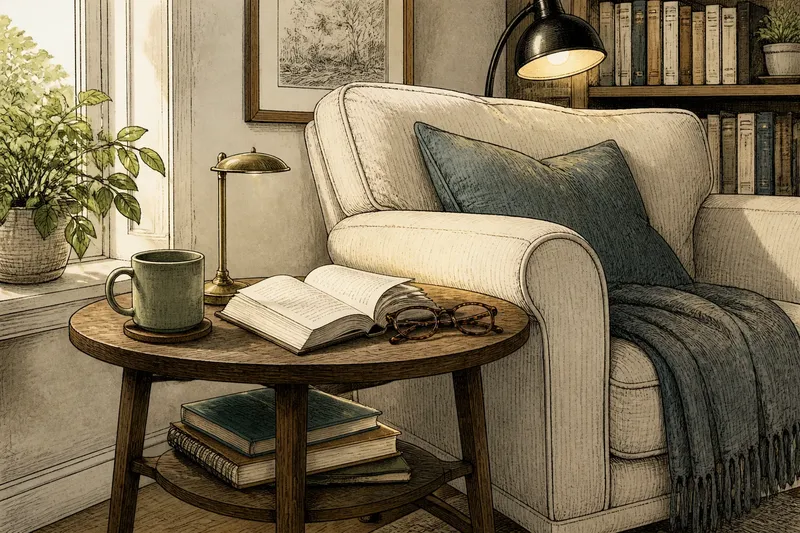
A side table for a reading corner should fit the things you reach for while seated, not merely fill the gap beside the chair. Start with the book, reading glasses, drink, lamp or other regular companions; then compare their demands with the table’s top, height and footprint. That order makes the choice less like furniture shopping and more like solving a small, useful puzzle.
There are three sensible approaches: a compact table for a short list of essentials, a broader surface for several items used together, or a divided or nested arrangement when the routine changes. Each can work. The right one depends on what the corner is for, how the chair is positioned and how much floor it can spare.
Start with the reading routine
Before considering shape or finish, notice what actually arrives in the corner. A reader who uses a paperback and a pair of glasses needs a different surface from someone who keeps a hardback open beside a cup, a small lamp and a notebook. The distinction is not a matter of taste; it changes how much uninterrupted top space is useful.
Think through a typical reading session, from sitting down to getting up. Which items are already in hand? Which are put down and picked up repeatedly? Which need to remain within easy reach without being moved aside? A drink may be occasional; glasses, a bookmark and the current book may be constant. Give priority to objects that are handled while seated, rather than those that merely look plausible in a photograph.
Also notice where the chair places your arm. A table can have a generous surface and still be awkward if its useful area sits behind the chair arm or beyond a comfortable reach. The most usable section is often the part nearest the seated reader, not the centre of the top.
Say you read in an upholstered armchair with a paperback, glasses and a mug, and keep a floor lamp behind the chair. If the mug and glasses are repeatedly displaced to make room for the book, the problem is not a lack of decorative objects; it is a top that cannot hold the book open alongside them. A broader surface would be the likely improvement, while a table intended to support a lamp would solve a different problem.
Choose a table approach
A compact single table suits a corner with a restrained, predictable routine. It might hold a book and glasses, or a drink and a small reading light, but usually not several bulky objects at once. The benefit is a clear top and a modest floor presence. The limitation is equally plain: adding a lamp, notebook and cup can turn a neat surface into a game of domestic Tetris.
Choose this approach if the light comes from a wall sconce, floor lamp or nearby window and the table’s main job is to support what you are using. It also suits a chair close to a walkway, where a wide top would interfere with circulation. Look for a shape that lets the essential objects sit without hanging over an edge, rather than selecting the smallest possible table and hoping for good manners from the mug.
A broader single table suits a routine with several simultaneous objects. A reader may need the book open, glasses nearby and a drink set down without rearranging the whole scene each time. It is also useful when a table lamp must stand beside, rather than replace, the reading material. The trade-off is visual and practical: a larger top occupies more floor and can crowd the chair if the footprint is chosen without checking the room.
This is generally the straightforward option when the objects are used together and the available space can accommodate them. Compare the top with the actual arrangement, not the number of objects alone. A large book opened flat takes more room than a closed paperback; a lamp base can occupy a useful corner even when its shade sits above the surface. Allow enough open area for the item most often moved, rather than filling every part of the top with permanent fixtures.
A nested or divided arrangement suits a reading corner whose needs vary. A small pull-up table can provide temporary room for a cup or notebook, while a main table keeps the book and lamp in place. A two-tier table can separate items that should remain accessible from those used less often. These options can be helpful in a compact room, but extra parts only earn their keep if they are easy to use and do not obstruct the chair or the route past it.
Choose this approach if your routine changes from session to session or if you want a flexible surface without committing to one broad tabletop. Avoid it if you rarely move items around: additional tiers and sliding parts can become furniture for objects you do not use. A simple, stable top is not a failure of imagination.
Judge the tabletop
Once the approach is clear, assess the top against the objects. Shape matters less than the usable patch of surface. A round top can be convenient beside a curved chair, while a square or rectangular one may make better use of a narrow gap. In either case, check whether the objects fit together without forcing the book to sit at an angle or leaving the drink perched near the edge.
For a reading corner, account for the book in its working position. A closed book takes little room; an open one may need space for its covers to lie flat or for a reader to turn pages without sweeping other items aside. If the book is held in the lap most of the time, the table may only need to take glasses, a bookmark and a drink. Let the routine decide which state matters.
Consider the items that can spill, roll or snag. A cup is easier to place on a level, stable surface than on a very small ledge. A pen may roll from a rounded edge, and a trailing charging cable can catch on a projecting corner. These are not reasons to reject a whole table style; they are reasons to picture the actual objects on it and identify any awkward interaction.
Material should serve that use. Wood can provide a familiar, forgiving-looking surface, while glass keeps the object visually light but may show fingerprints and make a small object harder to see. Painted finishes can bring colour into the corner, though the surface should suit the care you are prepared to give it. Follow the maker’s guidance for cleaning and protection, particularly if cups or a lamp will sit directly on the top.
Set the useful height
Height determines whether the table behaves like a useful neighbour or an inconvenient shelf. A surface that sits well below the chair arm can be hard to reach without leaning. One that rises well above it may make a drink feel exposed and can compete with the arm’s space. Compare the table’s top with the arm and with the seated position in which you usually read.
The chair itself complicates the comparison. A soft cushion may compress when occupied, and a reclined posture changes where the hand naturally falls. Check the table beside the chair in its everyday position, not while the chair is pulled out for cleaning. If you are considering a table online, note its listed height and compare it with the chair rather than relying on a product photograph, where scale is often a polite fiction.
Height also matters for a lamp. A table lamp may need its base to sit securely on the top while the shade places light where the reader needs it. A low table may leave the light blocked by the chair arm; a tall one may put the shade close to eye level. If the lamp is an essential part of the setup, treat its dimensions as part of the furniture decision, not a finishing touch to be sorted later.
Check the floor footprint
A table must fit the room as well as the objects. Consider the space beside the chair, the path to the doorway and the movement needed to sit down or stand up. A top that seems modest on a product page can still project into a route or make the chair feel boxed in. Marking the proposed footprint with paper or removable tape gives a quick, reversible way to judge its presence.
Check the base as carefully as the top. A pedestal base may leave more room for feet than four legs, while a splayed base can occupy a wider patch of floor than its tabletop suggests. A C-shaped table can slide partly under some chairs, though the shape only helps if the chair’s base and legs allow it to fit. A design that cannot approach the seat closely may leave its useful surface too far away.
Take account of the chair’s movement. If it swivels, reclines or needs to be pulled away from a wall, a fixed table can become an obstacle. If the table sits on a rug, consider whether its legs rest steadily or catch at the edge. These details are easy to overlook when focusing on the surface, but they shape whether the table remains convenient after the novelty has worn off.
Which table fits your routine?
How much tabletop space do I need?
Start with the items used at the same time, then include the book in the position you usually read it. If a cup, glasses and an open book must share the surface, choose a top that lets each sit securely without repeated rearranging.
Should a side table match the chair height?
It need not match exactly, but it should be easy to reach from the seated position. Compare the top with the chair arm and consider how the cushion settles when occupied.
Is a round or square table better beside an armchair?
Neither shape is automatically better. A round table can soften a tight corner and avoid sharp corners in a close passage; a square or rectangular top may use a narrow gap more efficiently.
Can a small table hold a reading lamp?
Yes, if the base sits securely and leaves room for the other objects you need there. Check the lamp’s footprint and the light’s position alongside the chair before deciding that the table is large enough.
Make the final choice
Choose the compact table when the routine is simple and the floor is tight. Choose a broader top when several items are used together and there is room to accommodate them. Choose a nested or divided design when the arrangement genuinely changes, not because more surfaces sound inherently useful. This is the clearest way to select a reading-corner side table: let the objects set the demand, then check the top, height and footprint against the chair and room.
What is not worth the effort is buying a table for a hypothetical collection of accessories, then arranging the reading habit around the furniture. A spare surface can look orderly, but it should not require a carefully staged pile of books to justify its existence.
Before ordering, set the usual objects beside the chair and note which ones need to stay within reach. Measure the available floor area and compare the table height with the chair arm; if possible, mark the outline where the table will stand. A table that fits those ordinary conditions will be more useful than one chosen for a polished corner in which nobody is expected to read.